
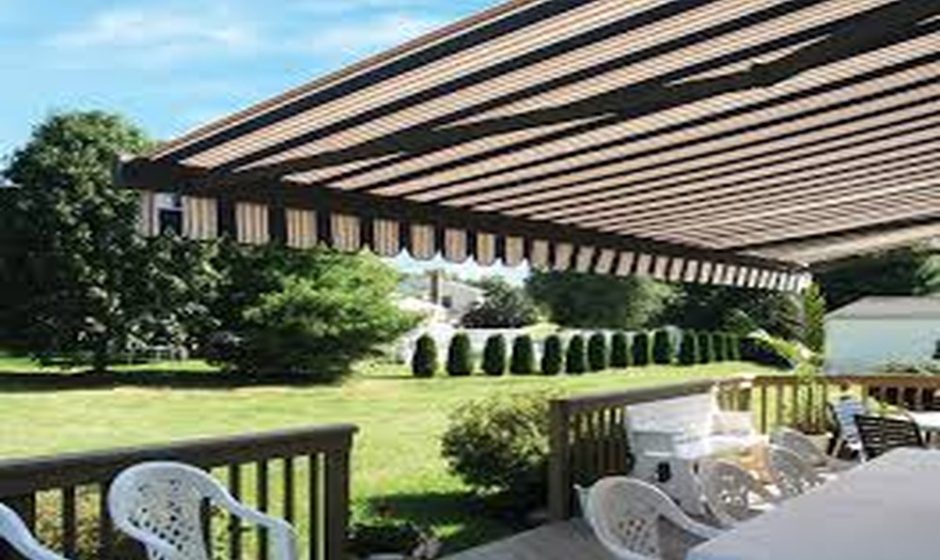

A manual awning is, in the long history of human solutions to the problem of sun and rain, one of the most direct and enduring answers ever devised, and in Singapore’s contemporary outdoor living market it continues to hold a position of genuine relevance that its more technologically elaborate competitors have not displaced. The case for the manual awning rests not on novelty but on a set of practical virtues that become clearer the more rigorously you examine what different shading systems actually deliver across years of real-world use. Understanding where manual systems excel, where they are outperformed, and how to maintain them correctly is the foundation of any purchasing decision that will hold up under scrutiny.
What a Manual Awning Actually Is
The mechanism is straightforward by design. A manual retractable awning uses a hand crank to engage a worm gear assembly that drives the articulated arms outward, extending the fabric canopy to its full projection. Reverse the crank rotation, and the arms fold back, drawing the fabric into the protective cassette housing. The parts involved are few, and the failure points, relative to motorised alternatives, are limited.
This simplicity is a genuine engineering virtue for the right category of user. A property owner with a modest residential balcony in Singapore, using the awning several times a week across manageable dimensions, will find that a well-manufactured manual awning system provides reliable, low-maintenance performance over many years with no electrical infrastructure requirements and no motor replacement costs.
Cost Comparison: Manual Versus Motorised
Typical manual awning price ranges in Singapore by installation size:
- Small awnings covering 2 to 3 square metres: SGD 600 to SGD 1,200 installed
- Medium awnings covering 3 to 5 square metres: SGD 1,200 to SGD 2,500 installed
- Larger residential awnings covering 5 to 8 square metres: SGD 2,500 to SGD 4,000 installed
Equivalent motorised systems typically carry a price premium of SGD 400 to SGD 800 above these figures, reflecting the cost of the tubular motor, control wiring, wall switch or remote receiver, and additional installation labour. Premium motorised systems with integrated wind and rain sensors add further cost above this baseline.
The honest comparison extends beyond purchase price. A motorised system requiring motor replacement after ten to twelve years adds SGD 400 to SGD 700 to the total cost of ownership. A manual crank awning in the same period requires only periodic lubrication and mechanism inspection. For budget-conscious buyers and those without convenient power supply at the mounting location, the total cost of ownership case for manual systems is compelling.
Where Manual Systems Are Outperformed
Three scenarios stand out clearly in Singapore’s context. First, awning spans exceeding four metres require considerably more physical effort to operate manually, which discourages frequent use. Second, Singapore’s sudden afternoon thunderstorms demand rapid retraction to protect fabric from wind loading and water saturation, and cranking a large awning home during a fast-approaching squall can result in significant stress before retraction is complete. Third, properties where crank access is awkward create ongoing inconvenience that erodes the appeal of an otherwise satisfactory manual awning.
Maintenance: What Consistent Practice Delivers
The long-term performance of any manual awning is determined more by maintenance consistency than by any other single factor. A structured maintenance schedule for Singapore conditions:
Monthly
Inspect the fabric for early mildew growth, particularly along seam lines. Clean affected areas with a mild soap solution and a soft brush, then allow to dry fully before retracting
Quarterly
Lubricate the worm gear mechanism and pivot points using a silicone-based lubricant. Avoid petroleum-based products, which degrade rubber seals and attract dust accumulation
Biannually
Inspect all fixing points for signs of movement, corrosion at fixing heads, or degradation of weatherproof sealant around anchor penetrations
Annually
Examine the fabric for UV degradation, fading, surface brittleness, or tears at stress points near arm attachment clips. Inspect cassette housing seals for cracking
Fabric longevity under Singapore conditions varies by material quality. Solution-dyed acrylic fabrics with UV treatment realistically deliver eight to twelve years of serviceable life. Untreated polyester fabrics may show significant degradation within three to five years of direct tropical sun exposure.
Practical Buying Considerations
Before purchasing a manual awning in Singapore, several questions merit direct answers from any supplier:
- What is the fabric composition and UPF rating?
- What aluminium grade is used for the frame and articulated arms?
- What warranty covers the mechanism separately from the fabric?
- Is the installation compliant with HDB town council or Management Corporation Strata Title requirements for your property type?
Conclusion
The enduring relevance of the manual awning in Singapore’s competitive outdoor shading market reflects a genuine alignment between the product’s practical virtues and the real requirements of a substantial portion of the market. Specify quality materials, commit to consistent maintenance practice, and match the system to the spatial and operational conditions it will actually face, and a well-chosen manual awning will deliver reliable, cost-effective outdoor protection for many years to come.