
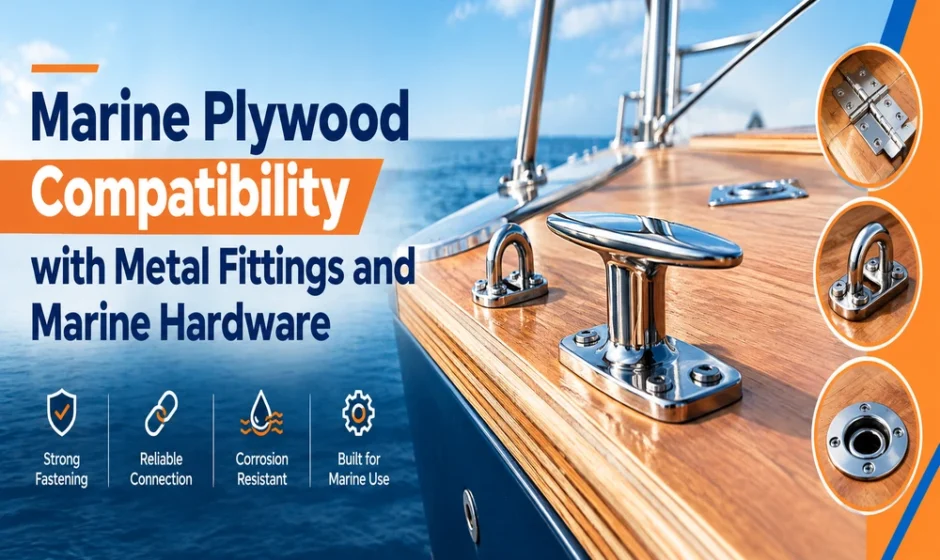

Marine hardware and plywood are exposed to water and wetting conditions in the marine environment. While both materials have the potential to deteriorate when exposed to wetness and prolonged moisture, marine hardware generally does not provide the same level of stability to a fitting or connection as plywood does. A fitting may fail due to moisture damage, but a professional contractor using appropriate marine hardware assumes that the supporting structure will provide adequate support. If the marine hardware is tested to see how moisture affects its performance, it may be found to be even weaker than what was anticipated.
However, all marine hardware and plywood-type materials must be designed to withstand water exposure and the associated effects of moisture. To determine if a fitting can withstand the effects of moisture, all marine hardware and plywood connections must be designed with the same specifications. Although there are variations between the various marine hardware and marine plywood connections, in order to ENVIRO the marine hardware connection with an appropriate supporting structure, it is necessary for the marine hardware and the plywood type material to be constructed according to the same ENVIRO standards.
While choosing a good plywood for your boat or other marine application, you’ll want to consider the following factors: that plywood is less likely to swell, delaminate, and degrade at the points where it is installed with hardware; and that the metal hardware being installed will work well in the marine environment.
Marine Plywood for Hardware Connections
High quality Marine Plywood helps to satisfy the plywood portion of this equation with waterproof phenolic resin bonding and void-free construction. Waterproof phenolic resin bonding prevents the panel from allowing moisture to penetrate it, while void-free construction helps to eliminate possible points of entry for moisture into the plywood when installed. This is especially important around areas where there are drilled holes or fastening points, as moisture can easily enter through these holes if they were improperly detailed.
Dimensional Stability is Important
In most cases, the fitting used to install the plywood will need to be installed at an exact location. If the plywood substrate warps or swells after the fitting has been installed, this can affect the alignment of the hardware and put excessive stress on the fixing point.
The supplied material states that Marine Plywood is dimensionally stable and not susceptible to warping or swelling when subjected to high-moisture areas. While this characteristic is beneficial in providing a more consistent substrate for marine fasteners, it should also be noted that the final result of the installation will depend on many factors, including the type of structure surrounding the plywood, the quality of the installation, and the degree of exposure to the elements.
It’s the Environment that Determines the Fitting Type
Marine Plywood does not mandate which type of metallic fitting should be used. The metallic fitting being installed should be selected based on the environment that it will be exposed to in use. So, for instance, the fasteners and fittings installed directly in contact with water, salt, or persistent moisture would have a lot different set of requirements than those fastened in a covered interior compartment.
The supplied material does not identify specific metals, fastener grades, or corrosion-resistance ratings for marine-grade metal hardware. Therefore, shoppers should determine which fasteners meet their requirements from the specifications provided by the manufacturer, rather than making assumptions based on the grade of the plywood. The plywood and metal fittings should be regarded separately from one another.
Obtaining an Effective Fixation
The fixation method and load placed on the hardware should match. Therefore, for large or heavy-fitting hardware, the fixation depth, plywood thickness, and/or additional structural support will likely need to be considered as opposed to merely opting to install with larger screws.
Prior to the fitting hardware being installed on the plywood, be sure to check the plywood thickness, location of the fixings, distance from the edge of the plywood, and what the expected load will be on the fitting. Do not installheavy-dutyd fasteners close to an unsupported edge of the plywood. In situations involving heavy loads, additional reinforcement, through-bolt connections, or more extensive methods of connecting via the plywood connection may be requested from the project’s designer.
If buyers wish to purchase Royale Touche Marine Plywood, it is a good idea to assess marine fittings and then to evaluate the documentation to verify that installing the plywood will help the installation of marine hardware. The supplied material indicates that Marine Plywood is designed to withstand the rigours of marine environments and has Waterproof Phenolic Bonding and quality hardwood veneers in the construction.
Conclusion
Marine Plywood is an excellent substrate for an array of applications with metal fittings and marine hardware. Marine Plywood’s Hardwood Veneers, Waterproof Phenolic Bonding, Void-Free construction, and Dimensional Stability are all excellent characteristics when water and structural loads will be experienced.