
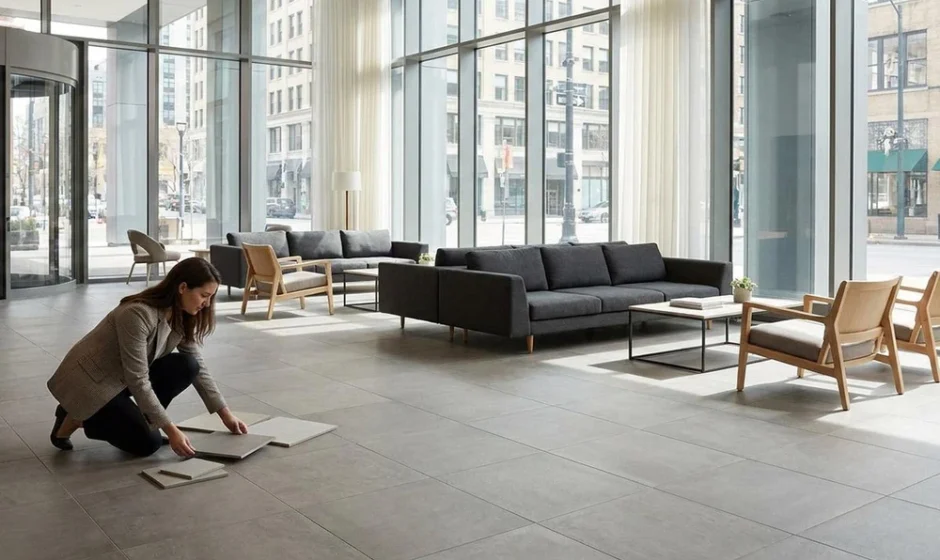

Sourcing materials for a commercial project (a restaurant, hotel lobby, retail space, or office build-out) involves a different set of questions than a residential kitchen or bathroom. Volume, durability standards, and consistency across an entire order all matter more than they do for a single-room remodel. At Trendy Surfaces, the Irvine and Laguna Niguel showrooms work with designers, architects, and contractors on exactly this kind of specification, alongside the residential projects that make up most walk-in traffic.
Key Takeaways
- Commercial spaces generally require higher PEI ratings (durability against wear) than residential applications, especially in high-traffic areas.
- DCOF, a measure of wet-surface slip resistance, is often a compliance requirement in commercial settings, not just a preference.
- Dye-lot consistency matters more at a commercial scale, since a large order needs to match across every box and pallet.
- Lead times and material availability should be confirmed early, since commercial quantities are larger than typical residential orders.
- Working directly with a showroom for samples and specs, rather than ordering sight unseen, reduces the risk of mismatched material arriving on site.
What Makes Commercial Sourcing Different
Commercial material sourcing generally involves larger quantities, stricter durability requirements, and more coordination than a single residential room. A designer or contractor specifying flooring for a restaurant or office is not just choosing a look; they are choosing a product that needs to perform consistently across thousands of square feet and hold up to volumes of foot traffic a home never sees.
That difference shows up most clearly in two ratings worth understanding before specifying any commercial tile: PEI and DCOF.
PEI Rating: Matching Durability to Traffic
The PEI rating measures how resistant a ceramic or porcelain tile is to surface wear, on a scale from 0 to 5, with higher numbers indicating greater durability. Residential kitchens, bathrooms, and entryways generally call for PEI 3 to 4, while high-traffic commercial spaces like retail stores and restaurants typically require PEI 4 to 5, and heavy-use environments like airports or hospitals often call for the maximum PEI 5 rating.
Specifying a tile with too low a PEI rating for a commercial space is one of the more common and costly mistakes in a project, since the wear becomes visible long before the space is due for a renovation.
DCOF: Slip Resistance as a Compliance Issue
DCOF (dynamic coefficient of friction) measures how much traction a tile provides on a wet surface, and a DCOF of 0.42 or higher is the standard benchmark for safe interior flooring in wet conditions. In commercial settings, meeting this benchmark is often a compliance requirement rather than an optional safety feature, given the liability involved in a public space.
For outdoor or pool-adjacent commercial applications, an even higher DCOF is often appropriate, since those surfaces see water more consistently than an interior floor.
In a commercial space, slip resistance is not a design preference; it is a number you have to hit.
Dye-Lot Consistency at Scale
For a single bathroom, small color variation between tile boxes is rarely noticeable. Across a hotel corridor or restaurant floor, the same variation becomes obvious, which is why dye-lot consistency matters more at commercial volume than it does for most residential jobs. Confirming that an entire order comes from the same production run, and ordering a small overage to account for cuts and waste, helps avoid a visible mismatch partway through installation.
This is one of the clearest reasons to work directly with a showroom on a large order rather than sourcing piecemeal from multiple suppliers, since consistency is far easier to guarantee from a single, verified batch.
Lead Times and Availability for Large Orders
Commercial quantities are large enough that availability needs to be confirmed early in a project, well before installation is scheduled. A material that is readily in stock for a single room may need to be special-ordered at commercial volume, which can add weeks to a timeline if it is not accounted for during the design phase.
Building in a buffer for lead time, and confirming total quantity needs against actual stock rather than catalog availability, avoids the kind of last-minute scramble that delays a commercial opening.
Working With a Showroom on Specification
Requesting physical samples, rather than specifying from a catalog image alone, remains one of the most reliable ways to avoid surprises on a commercial job, since finish, texture, and color can all look different in person than they do in a photo. A showroom visit also gives a designer or contractor the chance to ask directly about PEI, DCOF, dye-lot availability, and lead time for the specific quantity a project needs.
Trendy Surfaces works with design and trade professionals on exactly this kind of specification, alongside its residential showroom business, sourcing curated tile and stone from Italy to India for both scales of project.
Sourcing materials for a commercial project? The team at Trendy Surfaces has been helping Orange County homeowners, designers, and contractors find the right tile, stone, and flooring for their projects.
Visit the Irvine Slabyard & Showroom at 17912 Cowan, Unit C, Irvine, CA 92614, or call (714) 284-0118. Or stop by the Laguna Niguel Design Center at 23811 Aliso Creek Road, Ste. 176, Laguna Niguel, CA 92677, or call (949) 446-8121. Material availability, pricing, and lead times vary by project and are confirmed in the showroom or by quote.
FAQ
What PEI rating is needed for a commercial space? It depends on traffic level. Retail and restaurant spaces typically need PEI 4 to 5, while very high-traffic environments like airports and hospitals often require the maximum PEI 5 rating. Lighter-traffic commercial areas may work with PEI 3 to 4.
What does DCOF mean for tile flooring? DCOF measures slip resistance on wet surfaces. A DCOF of 0.42 or higher is the standard benchmark for safe interior flooring in wet conditions, and it is often a compliance requirement in commercial settings.
Why does dye-lot matter for large orders? Tile color can vary slightly between production runs, and that variation becomes more noticeable across a large commercial installation than in a single residential room. Ordering from a consistent dye lot, with a small overage, helps avoid visible mismatches.
How much lead time should I plan for a commercial tile order? It varies by material and quantity, but commercial volumes often require more lead time than typical residential orders, especially for special-order materials. Confirming availability early in the design phase helps avoid delays.
Should I order samples before specifying tile for a commercial project? Yes. Physical samples show finish, texture, and color more accurately than a catalog image, which reduces the risk of a mismatch between what was specified and what arrives on site.