
You already know the basics of asphalt. You want roads that hold up, look clean, and stay safe through hot summers, ice, and heavy traffic. I focus on what works in this region and I judge every step by one standard: will the pavement still perform years from now.
I base the guidance here on proven construction practices, regional climate data, and the failure patterns I see across Central Ohio roads. I will show you how lasting roads get built, the questions that protect your budget, and the contractor traits that point to durable results. If you need road paving Columbus Ohio, I suggest you pick a partner that understands our soils, traffic loads, and weather windows.
Why Central Ohio Roads Succeed or Fail
Roads fail for predictable reasons. Most problems start below the surface. Good plans solve that.
- Freeze-thaw cycles move water through the structure
- Fine-grained subgrade soils soften and pump under load
- Poor drainage traps moisture
- Thin or weak base layers can rut and crack
- Cold joints and low density shorten pavement life
If you control water, build a strong foundation, and hit density targets, the road lasts. That is the playbook.
The Build That Lasts: From Ground to Surface
1) Investigation and Design
Before construction, make the road match its mission.
- Map traffic type and volume
- Sample and classify soils
- Check drainage paths, ditches, and structures
- Set thickness by load, not guesswork
- Plan cross slope for runoff, often 2 percent
- Pick binder grades that fit our climate
For Central Ohio, a thicker base and a binder grade that resists rutting in heat and cracking in cold pays off.
2) Subgrade Prep
The subgrade is the foundation. Treat it with care.
- Strip organics and soft spots
- Shape and compact to a firm, uniform plane
- Use geotextile or stabilization where soils need help
- Proof-roll to find weak areas before stone arrives
If the proof-roll shows movement, fix it now. Do not bury problems.
3) Aggregate Base
A dense, well graded base carries load and sheds water.
- Use clean stone with fines that lock in
- Place in lifts and compact each lift
- Hit target thickness for the traffic class
- Maintain crown and shoulder support
Edge support matters. Strong shoulders prevent edge cracking and unraveling.
4) Asphalt Mix and Binder Choices
Match the mix to traffic and climate.
- Use a base course for strength
- Use a binder course to bridge
- Use a surface course for smoothness and skid resistance
- Consider polymers for added crack and rut resistance
Ask for a mix design that meets Ohio spec, with plant quality controls and test reports.
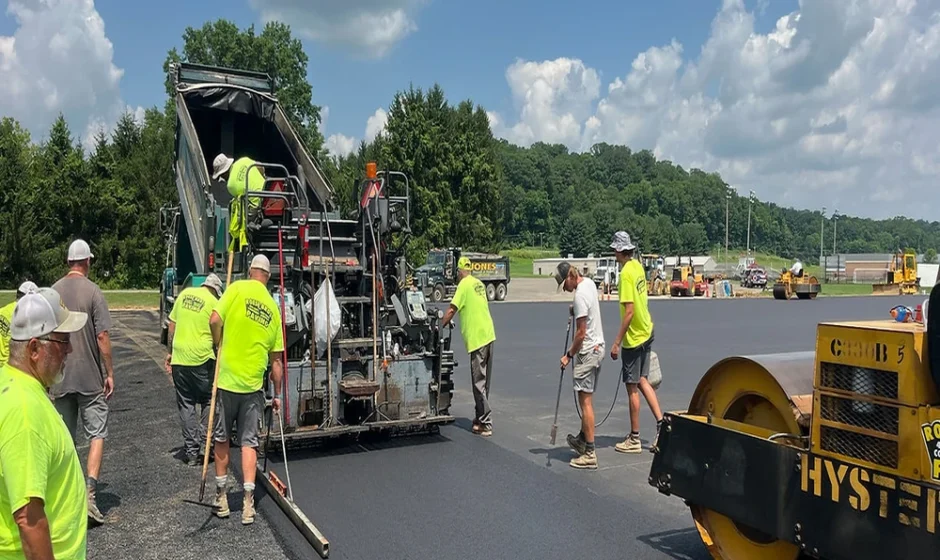
5) Paving and Compaction
Production details decide life span.
- Pave in the right temperature range for placement and compaction
- Keep a steady plant-to-paver feed to avoid stops
- Apply tack coats between lifts for bond
- Compact with the right roller pattern while mat temp is in range
- Build tight, straight joints with joint heaters or notch wedge methods
Density is king. Target the spec range and verify with testing. Low density lets air and water in.
6) Joints, Edges, and Drainage Structures
Water will find the weak link.
- Seal longitudinal joints
- Match curb and gutter grades to move water away
- Set inlets at correct elevation
- Provide ditch capacity and outfalls that stay clear
If water sits on the surface or behind the curb, the pavement will show it.
7) Quality Control
Trust but verify.
- Field density tests by an independent tech
- Plant mix tests for gradation and binder content
- Core checks on thickness and density
- Smoothness checks and visual joint review
Keep test records and photos. Hold the team to the plan.
Plan Maintenance on Day One
A long-life road needs light care at the right time.
- Crack seal to block water
- Patch isolated failures before they spread
- Seal or micro-surface low-volume roads on a set cycle
- Mill and overlay before widespread base failure
- Keep ditches, culverts, and inlets clear
Snow and ice control also matters. Set plow shoes to protect edges. Use salt rates that cut ice without grinding the surface.
What Failure Looks Like and How to Prevent It
- Alligator cracking: base or subgrade failure. Prevent with strong base and good drainage.
- Ruts in wheel paths: mix or density issue. Prevent with the right binder, mix design, and compaction.
- Raveling and loose stone: bond or compaction issue. Prevent with tack, heat control, and roller timing.
- Edge breaks: weak shoulders. Prevent with stone shoulders or stabilized edges.
If you see early signs, fix causes, not just symptoms.
Contractor Selection: How to Pick for Long-Term Results
I suggest you use these checks:
- Central Ohio track record with roads, not only driveways
- Clear scope with thickness by traffic class
- Drainage plan and cross slope in writing
- Mix design submittals and density targets
- On-site leadership who can adjust to field conditions
- Traffic control plan that keeps the work zone safe and productive
- References from similar projects and available test data
Good contractors invite questions and show their plan before work starts.
Why Roese Bros. Paving Stands Out
Roese Bros. Paving brings deep roots in Central Ohio and a direct, hands-on approach. They are a family-owned business in Ashville with more than five decades in the craft. Members of the Roese family stay close to projects. That shows up in organized job sites and consistent scheduling.
They field modern paving equipment and handle a full range of work: private roads, subdivisions, commercial roadways, municipal projects, parking lots, driveways, and sports courts. That range signals a team that understands load demands and finish standards across different settings.
Here is what I value in their approach:
- Attention to base and drainage, not just the surface
- Smooth finished mats with clean joints
- Density focus for long-term durability
- Clear scope and steady communication
- Experience with Ohio weather windows and traffic staging
If you want a local crew that treats roadway paving as infrastructure, not just a thin layer, they fit that profile.
Budget and Phasing Tips That Protect Pavement Life
You can stretch dollars without giving up life span.
- Fund soil and drainage work first
- Right-size layer thickness by traffic, not by habit
- Phase by segments that keep joints out of wheel paths
- Use heavier sections at entrances and truck routes
- Reserve a line item for early crack sealing
Cutting quality on base, drainage, or density costs more later.
Your Next Steps
- Define the road’s mission and traffic
- Confirm soils and drainage needs with field checks
- Set thickness and binder grades for our climate
- Require density testing and joint control in the bid
- Pick a contractor with local road results and hands-on leadership
Build the foundation, manage water, and hit density. Do that, and Central Ohio roads stay smooth, safe, and strong for years. Roese Bros. Paving has the local experience, equipment, and standards to deliver that kind of result.